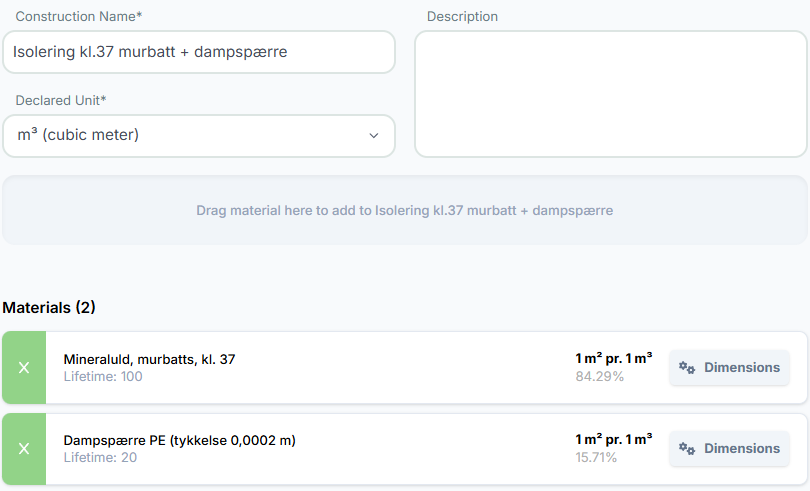
I would like to create a construction in the library which only contains insulation and a vapour barrier. This way, I can avoided adding the vapour barrier as a custom material, as the vapour barrier never gets modelled in Revit.
I have chosen m3 as the declared unit: 1 m2 pr 1 m3 has been set as the dimension for the insulation, so that the dimensions auto-scale. In other words, if I apply this on a wall with a insulation thickness of 270mm, the emissions scale to 270mm. This part should be pretty straight forward.
Now my question is whether the vapour barrier also scales?
I have chosen Dampspærre PE (tykkelse 0,0002 m) from Tabel 7 - BR18 (2025) as this product is declared in m2, meaning that I should only have 1 layer pr. m2.
Tried using this construction on a project, but I can’t really see if the vapour barrier also scales or not. Having 0,27 pieces of vapour barrier abviously wouldn’t be correct
That’s a great idea you’ve had, creating a construction in cubic meters that you can later scale according to the required thickness. However, in this particular case, with a membrane that has a fixed thickness and is measured in square meters, it’s unfortunately not possible.
The reason is that you can’t proportionally scale the membrane and the insulation together, doing so would either overestimate or underestimate the amount of membrane needed.
An example of a construction you can scale this way would be concrete and steel. The reason this works is that both materials are measured in volume percentages. For instance, if your concrete contains 2% steel reinforcement, that ratio will remain constant regardless of how you scale the volume.
That’s not the case with membranes and insulation, though. The membrane layer will always have the same thickness, while the insulation layer changes.
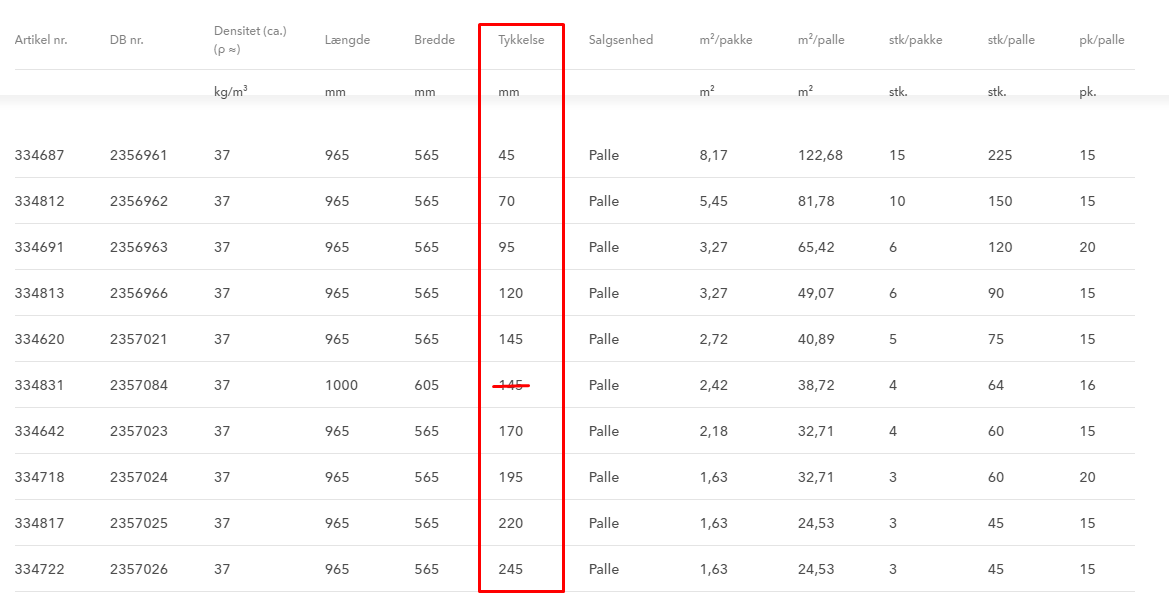
If I then have to make a custom construction for each of 34 types for different thickness - here I would use the normal thicknesses from rockwool batts as reference - we end up with 270 different constructions!!! That is not gonna happen
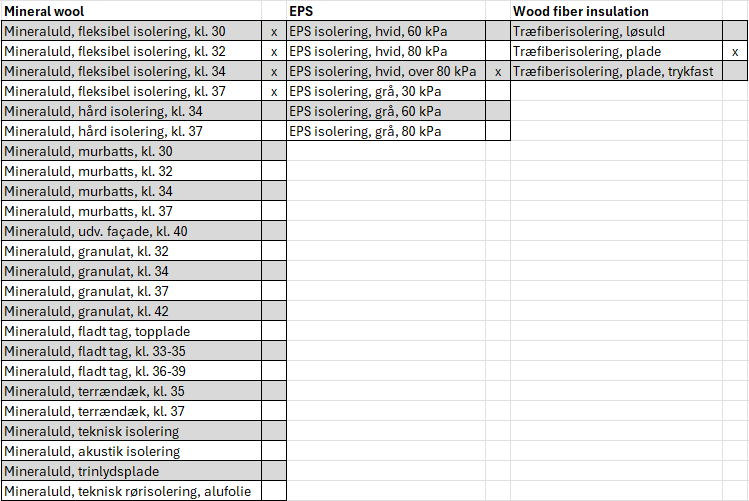
I could reduce this to the following types instead as a simplification:
Mineraluld, fleksibel isolering, kl. 30
Mineraluld, fleksibel isolering, kl. 32
Mineraluld, fleksibel isolering, kl. 34
Mineraluld, fleksibel isolering, kl. 37
EPS isolering, hvid, over 80 kPa
Træfiberisolering, plade
But that would still result in 54 constructions, which is also a lot of work and a lot of maintenance
You all know that I love coming with suggestions, so I’ll just add another one
Would you be able to add a Is scalable feature to custom constructions like shown below. This would allow us to do as I suggest, which would save a ton of time on mapping!
That’s actually a great idea. I’ve added it to our system, and it’s now listed as a suggestion for improving the platform.
What I usually do when I work with homogeneous insulation layers, and when the quantities come from Revit (often the quantities are available in m³), is that I have create the different insulation classes as constructions in m³ and then convert the insulation material from m2 to m³. For example, if it’s class 37:
1 / 0.037 = 27.03.
So that means I have 27.03 m² per m².
This might help reduce the number of constructions you need to create
What, isn’t the generic insulation in declared in m3? That is absolutely insane! So if I use generic insulation from BR18 Tabel 7 (2025) on a layer with 270mm insulation import from Revit, it ignores the thickness and calculates the emission from 37mm insulation? Wow, I think a lot of LCA’s a filled with errors then!
Can’t you just declare it in m3 instead?
And if not, you have to give an errormessage, when people use that material to inform people that the thickness of the material is ignored.
I think you also need to clarify the thickness of the material in the name in library.
Unfortunately, we are not able to scale the generic data ourselves. We have to follow the format used in Table 7 according to BR18, and therefore all insulation materials are reported in square meters. However, we are considering creating constructions where we convert all insulation materials to cubic meters instead.
Feature 1
Have you looked into a Is scalable feature yet
Feature 2
Have you
Added an errormessage/warning when people use insulation materials from BR18 table 7 warning them, that insulation should be converted to a construction? Maybe there should always be an warning message, when mapping a materiale with m2 as the declared unit.
Made constructions for each insulation type
Feature 2 is obviously the highest priority here - I’d dare say it should be among the very highest priority for your company right now!
I just tried making my own construction as you suggest Lucas. You write 27.03 m2 per m2, but do you mean m2 pr. m3 like below? Or am I entering this wrong?
We’ve implemented a temporary fix so you don’t have to calculate the factor for how many m² per m² of insulation you need in order to get a specific thickness yourself.
If you create a construction → create an inhomogeneous layer (if you only need mineral wool, you can simply drag and drop two insulation layers on top of each other and then delete one of them).
When you then enter your size into the inhomogeneous layer, it will scale automatically. See the attachment for an example with a class 34 insulation that is created as 1 m³.
So you enter 1 for the thickness of the inhomogeneous layer and 1 for the width, as well as the thickness as it is specified, i.e. **0.034
**
Thanks for the walkthrough and the workaround solution. However, isn’t it wrong that the construction in given in m2?
If I want the insulation material to scale according to the volume of my material (imported from Revit), the declared unit should be m3. Otherwise, the mapped material will disregard the volume and give it a thickness of 0,034 m, and then we are back at where we started