# Question to the users: How do you guys use Real-Time LCA in your daily practices?
**URL:** https://community.realtimelca.com/t/question-to-the-users-how-do-you-guys-use-real-time-lca-in-your-daily-practices/367
**Category:** General
**Created:** [September 15, 2025, 7:20am UTC](https://community.realtimelca.com/t/question-to-the-users-how-do-you-guys-use-real-time-lca-in-your-daily-practices/367 "2025-09-15T07:20:58Z")
**Posts on this page:** 3
**Page:** 1
### Author:  [@MarkLabrosse](https://community.realtimelca.com/u/MarkLabrosse)
#### Post date: [September 15, 2025, 7:20am UTC](https://community.realtimelca.com/t/question-to-the-users-how-do-you-guys-use-real-time-lca-in-your-daily-practices/367/1 "2025-09-15T07:20:58Z")
Hi everyone
I wanted to ask a question that is directed more to all the other users of RTLCA, not to the development team 😉
_How do you guys use Real-Time LCA in your daily practices?_
Our colleagues ask why our LCA’s can’t be made more real-time with RTLCA. We see 3 things that prevents us, from making calculations in near real-time.
### **1) Material layers lacking in our Revit models**
We see that there is usually is a lot of data that we can’t retrieve directly from the Revit model, e.g.
- Reinforcement of concrete constructions
- Timber- og steel joists between insulation layers
- Wet room membrane
- Vapor barrier
- Plaster and paint, etc.
So when we make an LCA, we go through each `Type` and add whatever materials might be missing according to a _bygningsdelsjournal_ (don’t know what that’s called in english). This also means that our colleagues need to make their _bygningsdelsjournal_ earlier that usually, which makes the project more expensive.
### **2) Lack of quick overview of the material take-off from Revit**
We also think that it is hard to get a quick overview of the quantity take-off in RTLCA in the moment - especially since you can’t see the thickness of the materials. I also talked about this problem in this thread:
> [@View information in branch](https://community.realtimelca.com/t/view-information-in-branch/137):
>
> Hi team I have another feature request, which would lighten the process for us users significantly. Right now, you need to click on each material to see the underlying data. It would be very useful, if this data was visible in the tree structure, like illustrated below. It would make it easier to see if the quantities area correct You would be able to check, if you’ve entered the correct service life time (especially handy in the materials view) If you want to add an extr…
So we have this excel spreadsheet, where we can calculate the thickness of a material from RTLCA using the area and volume, we can calculate how to input extra material layers, convert reinforcement from kg/m2 to kg, etc. This process is time consuming.
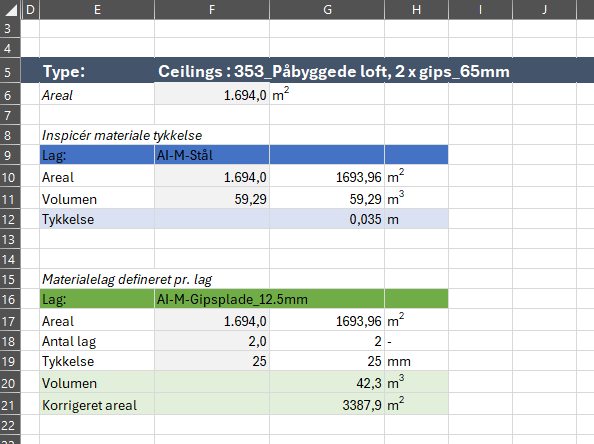
### **3) How manually added material layers are managed when exporting a new Revit model**
Another problem is when e.g. a wall has changed name in the Revit model. If I re-upload the model, it removes all `types` that don’t exist in the model any longer. So the old wall is delete, BUT if I have added extra layers manually, these are kept in the model, and I need to find them manually and delete them. And as those extra layers aren’t moved over to the “new” wall type, they have to be added manually again.
//
So all in all, there is still a lot of manual work involved in our LCA’s even though RTLCA saves us time, which brings us back to the original question:
_How do you guys use Real-Time LCA in your daily practices?_
Do you also make detailed LCA’s like this - also for the earlier stages? Or do you just make a quick LCA without adding materials manually and absorb the difference with a buffer or something?
Hope that people are willing to share their experiences so we can become better together 😊
---
### Author:  [@ELA](https://community.realtimelca.com/u/ELA)
#### Post date: [September 24, 2025, 9:20am UTC](https://community.realtimelca.com/t/question-to-the-users-how-do-you-guys-use-real-time-lca-in-your-daily-practices/367/2 "2025-09-24T09:20:50Z")
Hello Mark and community
I’m just starting to use RTLCA on projects and am currently working on a LCA report on a building in early design stage.
The Revit model is more of an architectural model without technical appliances, but with layers in the structure of the building components. We have a library of typical constructions to use in the first stages and this speeds the process up. I’ve materialmapped the typical constructions library, so for future projects the mapped library can be used as a reference to automap the new Revit model. I have not gotten the possibility to try this for a real project yet.
I agree that there still is manual work when mapping construction layers containing multiple materials. The construction function is more complicated to use than using Excel calculations in my opinion, I feel I have more control over the calculation.
Marks’ suggestion of having “branches” of information on the materials would be very nice. It would make it easier to check amounts!
A tool that I use alot when mapping is the NTI Find & Select tool and schedules in Revit. It isolates construction types and gives a better understanding of the model, especially when you are not the person that made the Revit model.
So I agree, RTLCA is not fully automated yet, but in general is a very useful tool that saves a lot of time. I’m excited for even more updates 🙂
---
### Author:  [@MarkLabrosse](https://community.realtimelca.com/u/MarkLabrosse)
#### Post date: [October 6, 2025, 7:51am UTC](https://community.realtimelca.com/t/question-to-the-users-how-do-you-guys-use-real-time-lca-in-your-daily-practices/367/3 "2025-10-06T07:51:09Z")
Hi Ela
We also use `Constructions` for early-stage volume study models from Rhino, where no thickness have been selected. This is a powerful tool that allows us to test designiterations and different construction type relatively quickly 👌
However, you have to beware. When you use a construction, layer thicknesses are predefined. So if you model a wall in Revit, thinking that the concrete wall is 150 mm thick, but your predefined construction is only 100mm thick, RTLCA will use the thickness of the construction rather than what has been defined in Revit. So we only use constructions for simple rhino models or for inhomogeneous single-layer constructions e.g. a timber-frame wall with insulation, etc.
So the constructions might be used for the first stage, but quickly becomes obsolete.